Regulating to Disaster by Diana Furchtgott-Roth
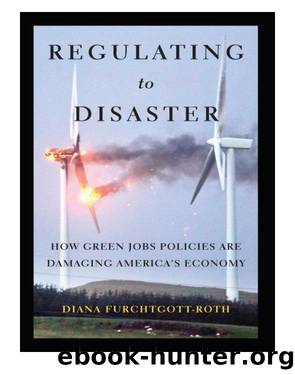
Author:Diana Furchtgott-Roth
Language: eng
Format: epub
Publisher: Encounter Books
Published: 2012-09-06T00:00:00+00:00
PART III
MORAL AND GLOBAL IMPLICATIONS
8
GREEN UNEMPLOYMENT FOR AMERICA, GREEN GROWTH FOR ASIA
On a rainy fall day in October 2011, a Washington, DC, think tank, Resources for the Future (RFF), was hosting a conference entitled âPerspectives on Green Economy and Green Growth.â Sponsored by the United States Council Foundation and the United States Council for International Business, participants included representatives from Shell Oil, General Electric (GE), the Environmental Protection Agency (EPA), and the Department of Energy (DOE). At the conference Francesca Costantino, the director of the DOEâs Office of International Science and Technology Cooperation, told participants that changing to green technologies was a two-step process. First, the government gives incentives to invest in a desired technology. Then, the government requires its use.
This has been the approach of the United States and European governments to wind, solar, and ethanol. But oddly, Costantinoâs presentation hardly discussed the economic costs of this approach. The vast majority of the attendees understood that shifting technologies was desirable, regardless of the cost.
The voice of reason at the conference was Brookings Institution senior fellow Charles Schultze, who gave a presentation on the disadvantages of the industrial policy that became fashionable in America during the 1970s.1 With Japan perceived as a major threat to American competitiveness and a successful practitioner of industrial policy, America had to follow in Japanâs footsteps. According to Schultze, âThe central problem was that the private market was directing investment to the wrong industries. To remedy these problems U.S. companies and the government should develop a coherent and coordinated industrial policy.â
Fast-forward to the present day, when industrial policy consists of government actions centered on the energy sector and the problems of global warming and environmental pollution. âAnd, instead of Japan, todayâs more limited green version of industrial policy sees China and its fast growing alternative energy industry as a major threat to American technological leadership,â said Schultze.
Some people, such as Costantino, might believe that federal incentives for green energy, such as wind and solar, will benefit the United States. Advocates declare that these technologies will result in the production of new systems, creating American green jobs. The theory goes as follows: Congress passes laws requiring the use of certain forms of alternative energy, just as it mandated ethanol and electricity produced from renewables. As a sweetener, Congress subsidizes them, perhaps with refundable tax credits for both businesses and households. Then, Americans produce them, eschewing old-fashioned technologies such as oil and coal. The result? America will grow faster, winning the modern equivalent of the Race for Space.
On some level, this sounds appealing. But the reality is that in most cases alternative technologies cannot stand on their own without permanent tax credits. And the technology is not Made in America, but Made in Asia. In fact, much mandated equipment, such as solar panels and wind turbines, is made abroad and imported from abroad.
In turn, Asian countries import our traditional fossil fuels and lower their costs of production. This helps Asia to grow and to add jobs even as America and Europe stagnate under higher energy costs.
Download
This site does not store any files on its server. We only index and link to content provided by other sites. Please contact the content providers to delete copyright contents if any and email us, we'll remove relevant links or contents immediately.
| Anthropology | Archaeology |
| Philosophy | Politics & Government |
| Social Sciences | Sociology |
| Women's Studies |
The Secret History by Donna Tartt(19092)
The Social Justice Warrior Handbook by Lisa De Pasquale(12191)
Thirteen Reasons Why by Jay Asher(8912)
This Is How You Lose Her by Junot Diaz(6889)
Weapons of Math Destruction by Cathy O'Neil(6281)
Zero to One by Peter Thiel(5802)
Beartown by Fredrik Backman(5759)
The Myth of the Strong Leader by Archie Brown(5509)
The Fire Next Time by James Baldwin(5449)
How Democracies Die by Steven Levitsky & Daniel Ziblatt(5219)
Promise Me, Dad by Joe Biden(5154)
Stone's Rules by Roger Stone(5088)
A Higher Loyalty: Truth, Lies, and Leadership by James Comey(4964)
100 Deadly Skills by Clint Emerson(4927)
Rise and Kill First by Ronen Bergman(4790)
Secrecy World by Jake Bernstein(4753)
The David Icke Guide to the Global Conspiracy (and how to end it) by David Icke(4720)
The Farm by Tom Rob Smith(4514)
The Doomsday Machine by Daniel Ellsberg(4490)
